
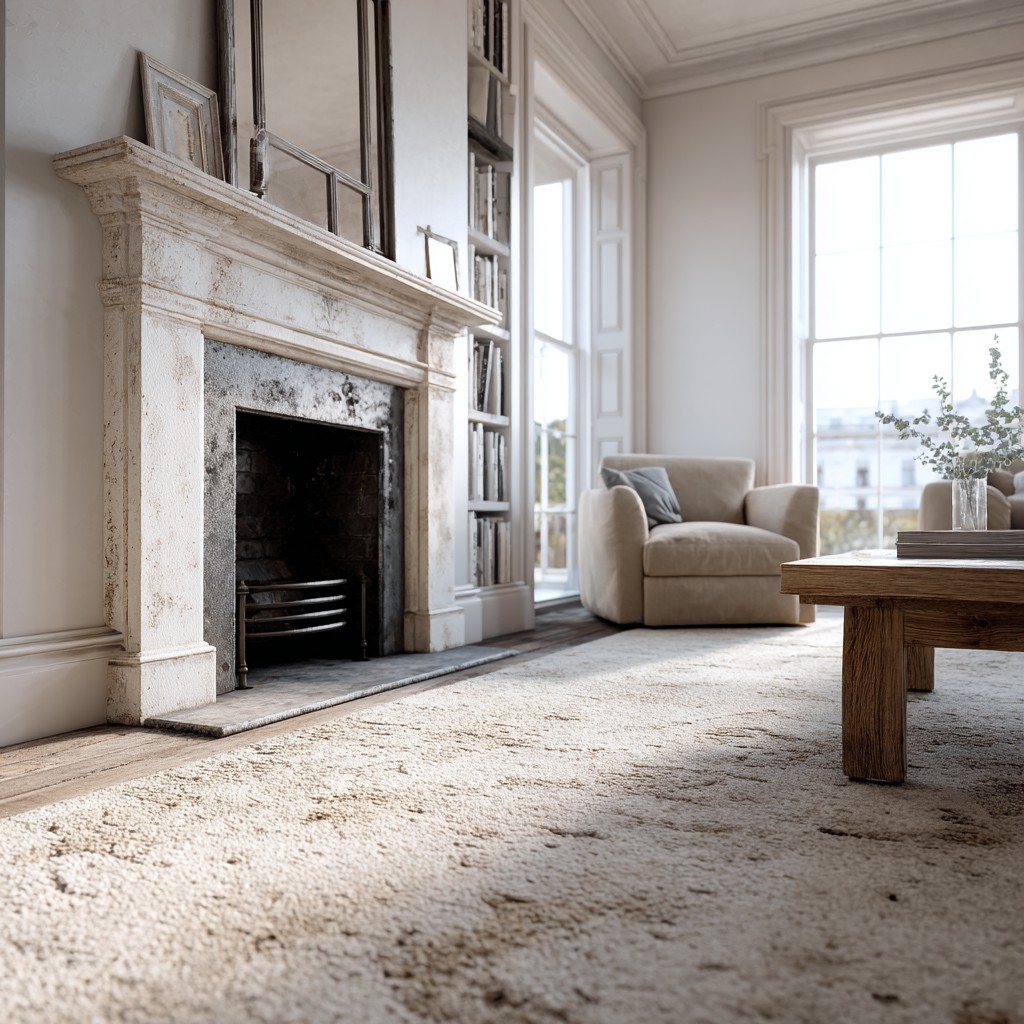
There’s a particular kind of smugness that comes with owning a period property in London. The cornicing. The original sash windows. The Victorian tiles in the hallway. The working fireplace that makes the living room look like the set of a Merchant Ivory film from October through March. It’s all enormously satisfying right up until the moment you realise that the hearth rug – and the carpet around it, and possibly a meaningful stretch of carpet leading away from it – has been quietly accumulating soot, ash, and the kind of deep-set grime that only a real fire produces, and that none of it is going to respond well to the methods you’d use on an ordinary carpet stain.
Soot on carpet is one of the more technically demanding domestic cleaning problems, and period properties compound it in specific ways. The carpets tend to be older, the pile tends to be deeper or more delicate, and the source of the problem – a genuine working chimney burning real fuel – produces a qualitatively different kind of residue to anything a gas fire or electric alternative generates. None of this makes it unsolvable. It does, however, make it a problem that punishes the wrong approach severely and rewards the right one disproportionately well.
Why Soot Behaves Differently to Almost Every Other Carpet Stain
Most carpet stains are wet problems. Wine, sauce, mud, pet accidents – they arrive as liquids or semi-liquids, and the cleaning logic that applies to them is broadly similar: contain it, lift it, treat the residue. Soot arrives as something else entirely. It’s a dry, ultra-fine particulate substance made up of carbon particles, unburned hydrocarbons, and – depending on what you’ve been burning and how efficiently your chimney draws – a range of other combustion byproducts that include tar compounds and volatile organic residues.
This matters enormously, because the instinct most people follow when they see a dark mark on a carpet is to reach for a damp cloth. Applied to soot, a damp cloth is close to the worst possible first response. The fine carbon particles that sit loosely on carpet fibres when dry will, the moment moisture is introduced, dissolve into a black liquid that penetrates immediately to the base of the pile and the backing beneath. What was a surface deposit becomes a deep stain in approximately three seconds. Soot, uniquely among common household carpet problems, must be approached completely dry before any liquid treatment is considered.
The Specific Chemistry of Fireplace Residue
A real fireplace burning wood or coal doesn’t just produce soot in the straightforward sense. It produces a layered residue that accumulates over a heating season in distinct forms. The light, powdery grey ash that settles near the hearth is the relatively benign component – mainly mineral residue, relatively inert, and physically retrievable if handled carefully. The black soot that travels further – carried by air currents, draught patterns, and the general convection activity around a working chimney breast – is the carbon-heavy fraction, and it behaves more like a pigment than a conventional stain.
The third component is the most problematic and the least visible: the tarry, oily condensate that forms when combustion gases cool and deposit on nearby surfaces. In a carpet that’s been near a working fire for several seasons, this tarry residue acts as a binder, gluing carbon particles to individual fibres and creating a stain that has both a physical and a chemical dimension. It’s this component that explains why a carpet near an older fireplace can look progressively darker over time even without any dramatic single incident – and why simply vacuuming it, season after season, doesn’t seem to make much difference.
The Dry Retrieval Phase – More Critical Here Than Anywhere Else
The cardinal rule of soot on carpet is this: nothing wet touches the affected area until everything that can be removed dry has been removed dry. There are no exceptions to this rule, and no circumstances under which it’s safe to skip ahead.
Start with a clean, dry white cloth or paper towel held just above the surface and pressed down gently – not rubbed, not dragged, simply pressed and lifted. The goal at this stage is to collect the loosely sitting surface particles without agitating them deeper into the pile. Work from the outer edge of the affected area inward. If the deposit is fresh from a recent fireplace incident – a collapsed coal, a puff of backdraft, a enthusiastic dog investigating the hearth at speed – this initial blotting will retrieve a meaningful amount of material.
Next, the vacuum. And here the technique matters as much as the equipment. Do not press a standard vacuum head firmly into the pile and drag it. Use a nozzle or crevice tool held fractionally above the surface, allowing the suction to draw particles upward rather than the mechanical action of the brush roll to grind them further in. Multiple slow passes in different directions. Change the bag or empty the canister before you start if it’s anywhere near full – reduced suction is the enemy here.
Why Period Property Carpets Require Extra Caution at This Stage
Older carpets – the kind of deep wool pile or Axminster that you might find in a Victorian or Edwardian property, or even a well-preserved mid-century carpet in a period conversion – are physically more fragile than their modern synthetic equivalents. The fibres may be more brittle, the dyes less colourfast, and the backing more susceptible to damage from excessive moisture or mechanical agitation. Vigorous vacuuming with a rotating brush roll on an older wool carpet near a fireplace can cause pilling, fibre distortion, and – if the carpet has any pre-existing wear near the hearth, as most do – outright damage to the pile structure. Suction only, applied carefully, is the right approach.
Moving to Wet Treatment – The Right Products and the Right Order
Once you’ve retrieved everything that dry methods can reach, you’re left with the bound residue – the carbon particles held in place by tarry deposits and the general deep-set grime of accumulated seasons. This is where wet treatment begins, and the product selection matters considerably more than it does for a straightforward food stain.
A small amount of clear washing-up liquid in cold water, applied by blotting, will address the surface layer of the tarry binder. Work in small sections, blot out thoroughly, and assess before moving forward. For the carbon pigment component that remains after the oily residue has been addressed, a dry-cleaning solvent – available from specialist cleaning suppliers and some hardware shops – is significantly more effective than a water-based solution. These solvents are formulated specifically for carbon-based and oil-based stains and will lift residue that water chemistry simply cannot reach.
Apply the solvent sparingly on a clean white cloth, blotting from the outside edge inward, and ventilate the room properly while you work. These are not products to use in a closed room, and they’re not products to leave on carpet longer than the instructions specify.
The Particular Challenge of Set-In Seasonal Soot
A single dramatic incident – a soot fall, a chimney backdraft, a fire screen that failed at a critical moment – is actually easier to address than the alternative: the gradual, season-long accumulation of light soot deposits that have been partially vacuumed, partially ignored, and repeatedly walked over across several winters. This kind of set-in soot has had time to work its tarry components deep into the fibre structure, has been mechanically compressed by foot traffic, and has often combined with other household soiling to form a composite stain that doesn’t respond neatly to any single treatment approach.
Patience is the operative quality here. Multiple light applications of solvent-based cleaner, each followed by thorough blotting and drying before the next, will achieve more than a single heavy-handed application that over-saturates the pile and risks spreading the problem.
The Period Property Variables That Change the Calculation
A London period property isn’t a single category – it’s a broad church that encompasses everything from a Grade II listed Georgian townhouse in Islington to a robustly built Edwardian semi in Walthamstow, and the carpet situation in each is likely to be entirely different.
Older properties tend to have more draughty chimney arrangements, which means soot travels further into the room and affects a larger area of carpet. They’re also more likely to have original floorboards beneath the carpet with gaps that create upward airflow, distributing fine particles in ways that defy the usual logic of “it’s worst nearest the hearth.” A carpet in a room with a working fireplace and original draughty floorboards can accumulate soot across its entire surface over a season, not just in the immediate hearth area – a slow, even darkening that reads as general dinginess rather than an identifiable stain.
Chimney condition is another variable that period property owners often underestimate. A chimney that isn’t drawing cleanly – due to age, partial blockage, or architectural quirks common in older London properties – produces significantly more soot fallout into the room than one in good working order. If you’re finding that your carpet near the fireplace needs attention every season despite careful management, the chimney itself is worth investigating before the carpet is.
When a Heating Season’s Worth of Use Needs a Proper Reset
There’s a rhythm to real-fire living in a period London home. You light the first fire sometime in October, you enjoy seven or eight months of genuinely lovely evenings, and you emerge in April into the light wondering quite what has happened to the carpet in that room. It looks tired. It looks darker than it should. The area nearest the hearth has a flatness to the pile that vacuuming doesn’t shift, and there’s a faint but persistent smell that isn’t entirely unpleasant but definitely wasn’t there before the clocks went back.
This is not a failure of maintenance. It’s simply what a real fire does to the space around it over an entire heating season, and it’s entirely normal in the context of a working period property. The appropriate response at the end of the season – before the fireplace is cleaned, the mantelpiece dusted, and the whole room given its spring refresh – is professional hot water extraction combined with a pre-treatment formulated specifically for carbon-based soiling. The extraction process reaches the full depth of the pile, flushes the tarry residue that dry methods and surface wet treatment can only partially address, and restores the pile structure in a way that no amount of careful home treatment quite manages to replicate.
It’s also, frankly, the only way to properly reset a carpet that’s been doing its job loyally all winter in one of the most atmospheric – and demanding – domestic environments that London housing has to offer.