
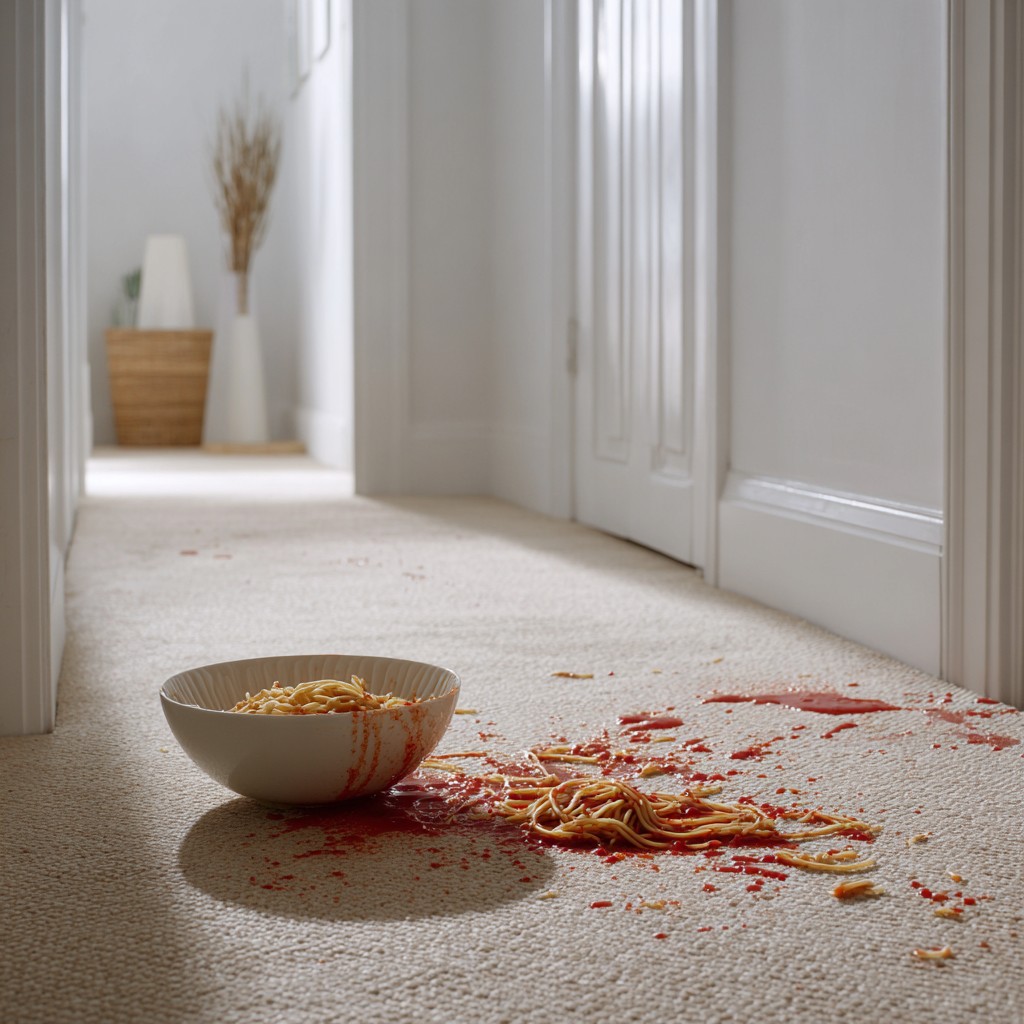
You heard it before you saw it. That specific silence after a clatter – the kind that makes your stomach drop – followed by the sight of a generous bowl of spaghetti bolognese face-down on your cream hallway carpet. It’s a moment that transcends language. Whether you whispered something unrepeatable or simply stood there in mute horror, the question forming in your mind was the same one that brings most people to this article: can this actually be fixed?
The honest answer is yes – probably, and certainly more completely than you think – but with two important conditions attached. Speed matters enormously, and technique matters almost as much. Tomato sauce on a cream carpet is not a death sentence for your flooring, but it is absolutely an emergency that rewards calm, methodical action over frantic scrubbing. Take a breath. Let’s work through this properly.
Why Tomato Sauce Is Such a Nightmare on Light Carpets
Not all food spills are created equal, and tomato sauce sits near the top of the stain hierarchy for good reason. The trouble isn’t any single component – it’s the combination. You’re essentially dealing with a three-pronged attack on your carpet fibres simultaneously, which is why it behaves so differently from, say, a splash of orange juice or a dropped biscuit.
Cream and off-white carpets make every bit of this worse. A dark or patterned carpet can disguise the evidence of your pasta night for years. A cream hallway carpet, by contrast, is essentially a confessional. Everything shows, everything stays visible, and every failed cleaning attempt leaves its own additional mark on the record.
The Trifecta of Trouble: Pigment, Acid, and Fat
Break tomato sauce down and you’ll find three distinct problems sharing a bowl. First, there’s lycopene – the deep red pigment that gives tomatoes their colour. Lycopene is a remarkably stable compound, which is great news for your cardiovascular health and genuinely terrible news for your carpet. It binds to fibres tenaciously and resists water on its own.
Second, there’s the acidity. Tomatoes are naturally acidic, and over time that acid can interact with the dyes used in carpet fibres, particularly wool, potentially causing subtle but permanent colour changes that no amount of cleaning will reverse.
Third – and this is the component that most people overlook – there’s the fat. Whether it’s olive oil from your soffritto, the rendered fat from minced beef, or the oil used to cook the sauce, that fatty residue acts as a fixative. It helps the pigment and acid cling to fibres rather than sitting on the surface where they could be more easily removed. Together, these three elements make tomato sauce one of the more genuinely challenging domestic stains in existence. Understanding that is the first step to treating it correctly.
The Golden Window – Why the First Ten Minutes Matter Most
Tomato sauce stains don’t set instantly, but they do set progressively and with alarming speed. What can be lifted relatively cleanly in the first five to ten minutes becomes a genuine challenge after an hour. Leave it overnight, let it dry and bond to the fibre, and you’re looking at a stain that will require serious professional intervention – and may still leave a ghost mark behind.
The instincts most people follow in this situation are, unfortunately, almost perfectly wrong. The urge to rub vigorously feels productive but actually spreads the stain laterally and forces the sauce deeper into the pile. Pouring hot water over it – understandable, but catastrophic – essentially cooks the proteins in the sauce, bonding them to the fibres in a way that’s very difficult to reverse. And reaching for whatever cleaning spray is under the sink, without checking its ingredients, risks setting the stain permanently or adding a bleach mark to your problems.
Your Emergency Response in the First Five Minutes
This is triage, not cleaning. The goal right now is containment, not removal. Work through these steps in order and resist the urge to improvise.
Start by removing as much of the physical sauce as possible. Use a spoon or a blunt knife – never a cloth at this stage – and scoop gently from the outside of the spill inward. You’re lifting, not smearing. Once the bulk of the solids are gone, take a clean white cloth (white matters – coloured cloths can transfer dye) and blot the area. Press firmly and lift. Do not rub, do not scrub, do not go back and forth like you’re polishing something. Blot, lift, move to a clean section of cloth, repeat. Continue working from the outer edge of the stain toward the centre to prevent the sauce spreading into clean carpet. This is the moment that determines how the rest of this goes.
The DIY Treatment Method That Actually Works
Once you’ve completed the triage phase, you can move into active treatment. The good news is that the products you need are almost certainly already in your kitchen.
Start with cold water – always cold, never warm – applied sparingly to the stained area. Blot it out with a clean cloth. This dilutes the residual sauce without setting it. Next, mix a small amount of clear washing-up liquid (a teaspoon to 250ml of cold water) and apply it gently to the stain with a cloth, again using a blotting motion. Allow it to sit for two to three minutes, then blot it out thoroughly. Follow this with a white wine vinegar solution – one part vinegar to two parts cold water – which helps to tackle the remaining pigment and neutralise the acidity. Blot, don’t rub, and rinse with cold water once more. Finish by placing a clean dry cloth over the area and weighting it down with something heavy, allowing it to absorb the remaining moisture as the carpet dries.
The Products to Reach For (and One to Avoid)
Clear washing-up liquid is your primary ally here. Not blue, not green, not the fancy pomegranate-scented one your partner bought – clear, standard washing-up liquid, which won’t risk adding its own colourant to an already complicated situation. White wine vinegar is excellent for tannin and pigment stains. Cold water is non-negotiable throughout.
For stubborn residual colour that survives the above treatment, a weak hydrogen peroxide solution (a three percent solution, the kind sold in chemists as antiseptic) can be applied sparingly – but always patch-test on a hidden area of carpet first. On some cream carpets, particularly those with optical brighteners in the fibre, peroxide can cause lightening that’s just as visible as the original stain.
The product to avoid is any brightly coloured commercial carpet spray that hasn’t been specifically formulated for food stains. Many of these products contain surfactants that smell encouraging but leave a sticky residue behind – one that attracts dirt like a magnet and results in a patch that looks worse within a week than the original stain did on the night.
When You’ve Tried Everything and the Stain Is Still Smiling at You
There are circumstances where DIY treatment reaches its natural limit, and it’s worth being straightforward about what those are. If the sauce dried before you got to it, if the carpet was scrubbed rather than blotted at any point, or if you’re dealing with a wool or high-pile carpet that responds poorly to home cleaning products, you may find yourself left with a ghost stain, a sticky patch, or – worst of all – a pale bleached area where a well-intentioned product has done more damage than the bolognese.
This is where professional hot water extraction comes into its own.
What a Professional Clean Actually Does Differently
Hot water extraction – often called steam cleaning, though technically the water isn’t quite at steam temperature – is not simply a more powerful version of what you can do at home. The process is fundamentally different in several important ways.
Professional-grade pre-treatment solutions are formulated specifically for tannin-based and protein-based stains, breaking down the molecular bonds that hold lycopene and fat to carpet fibres before the extraction stage even begins. The extraction equipment then flushes the area with hot water at controlled pressure and immediately recovers the water at a rate that prevents over-wetting – one of the most common causes of mould growth beneath carpets after amateur deep-cleaning attempts. The result is a genuinely deep clean that reaches the base of the pile, not just the surface layer.
This isn’t a last resort reserved for hopeless cases. For valuable carpets, delicate fibres, or any situation where a DIY attempt has stalled and the stain is still partially visible, professional treatment is simply the smarter and more reliable option.
Hallway Carpets and the Unique Challenges They Present
The hallway is the hardest-working floor in any home and, in London particularly, it tends to be both narrow and relentlessly trafficked. In a Victorian terrace or a purpose-built flat with a corridor-style layout, the hallway carpet endures more footfall per square metre than almost any other surface in the house.
A stain here isn’t just sitting quietly waiting to be treated. It’s being walked over, ground in, and gradually spread across a larger area every time someone moves between the kitchen and the living room. The pasta transit zone, as it might reasonably be called, is exactly where this kind of accident tends to happen – and exactly where the consequences are most visible and most compounded by traffic.
This is worth bearing in mind when weighing up how thoroughly to address a stain. A mark in the corner of a spare bedroom is a cosmetic issue. A mark in the centre of a cream hallway is the first thing every visitor sees.
Prevention, Because Pasta Night Will Happen Again
It will. You know it will. The question is whether your carpet is in a better position to survive the next incident than it was this time.
Carpet protector treatments – fluorochemical applications in the Scotchgard family, professionally applied after a thorough clean – create a barrier around individual carpet fibres that gives you a meaningfully longer window to react before a spill bonds. They don’t make carpets stain-proof, but they do make them substantially more stain-resistant, which in practical terms is the difference between a blot-and-done situation and an evening of anxious scrubbing.
A well-chosen runner rug in a high-risk hallway section is also worth considering – both as a sacrificial layer over the most vulnerable stretch of carpet and, if you pick the right one, as a genuinely attractive addition to the space. Think of it less as admitting defeat and more as strategic interior design.